
Monroe County Court Records After a Jail Arrest
When an arrest happens in Monroe County, two separate record systems open. The Monroe County Sheriff's Office logs the booking, assigns a master name index number, and publishes custody information on its current-inmate and current-arrest pages. That is the jail side. The court side begins when the Monroe County State Attorney's Office, the prosecutor for the 16th Judicial Circuit, reviews the law enforcement reports and decides what formal charges to file. Filing a charging document opens a case in the Monroe County Clerk of the Circuit Court's criminal index, and that case becomes the official court record. Every hearing, motion, plea, and final outcome after an arrest is tracked in the clerk's docket.
The two sides answer different questions. The jail record shows who is in custody, where they are housed, and what bond amount is attached to each case number. The court record shows what the prosecutor formally accused the person of, how the charge has changed over time, and how the case ended. For custody detail and booking information, the jail inmate records page covers the sheriff's roster and how to read it. For booking photos tied to the arrest, the jail roster mugshots page explains the sheriff's current arrests feed. Court records after a Monroe County arrest live with the clerk, not the sheriff.
How to Find Court Records After an Arrest in Monroe County
The Monroe County Clerk of the Circuit Court maintains criminal cases online through a free public search at cr.monroe-clerk.com. The online index covers dockets from approximately 1990 to the present and documents from 2007 forward. A case number on the jail roster, such as 26CF521AK, is the fastest way in. Without a case number, a name search works if both the first and last name are entered. Date searches require both a start date and an end date. The clerk's online services home is at cr.monroe-clerk.com/Home.
- Open the clerk criminal search at cr.monroe-clerk.com/Attorney/SearchCriteria?caseType=CR and note the Case Type dropdown defaults to the criminal search.
- Enter the case number from the jail roster if one is shown, or enter the defendant's first and last name together in the name fields.
- Open the matching case and read the charge list, including the offense statute, level, and current charge status.
- Check each charge's code and level: CF means felony, MM means misdemeanor, and CT means criminal traffic.
When the online index returns no result, the reason is not always obvious. A case may not yet be filed, the name or date entered may not match the clerk's record exactly, the case may be confidential or sealed, or the matter may sit in a different court system such as federal court. Florida Chapter 119 gives the public broad access to court records, but section 119.0714 sets specific rules for court files and official records, and many exemptions narrow what a general internet search returns.
The Monroe County Clerk has three offices, all open Monday through Friday, 8:30 a.m. to 5:00 p.m. Key West is at 500 Whitehead Street, 305-292-3458. Marathon is at 3117 Overseas Highway, 305-289-6027. Plantation Key is at 88770 Overseas Highway, Suite 2, 305-852-7145.
The screenshot below is captured from the Monroe County Clerk criminal search portal at cr.monroe-clerk.com/Attorney/SearchCriteria?caseType=CR.
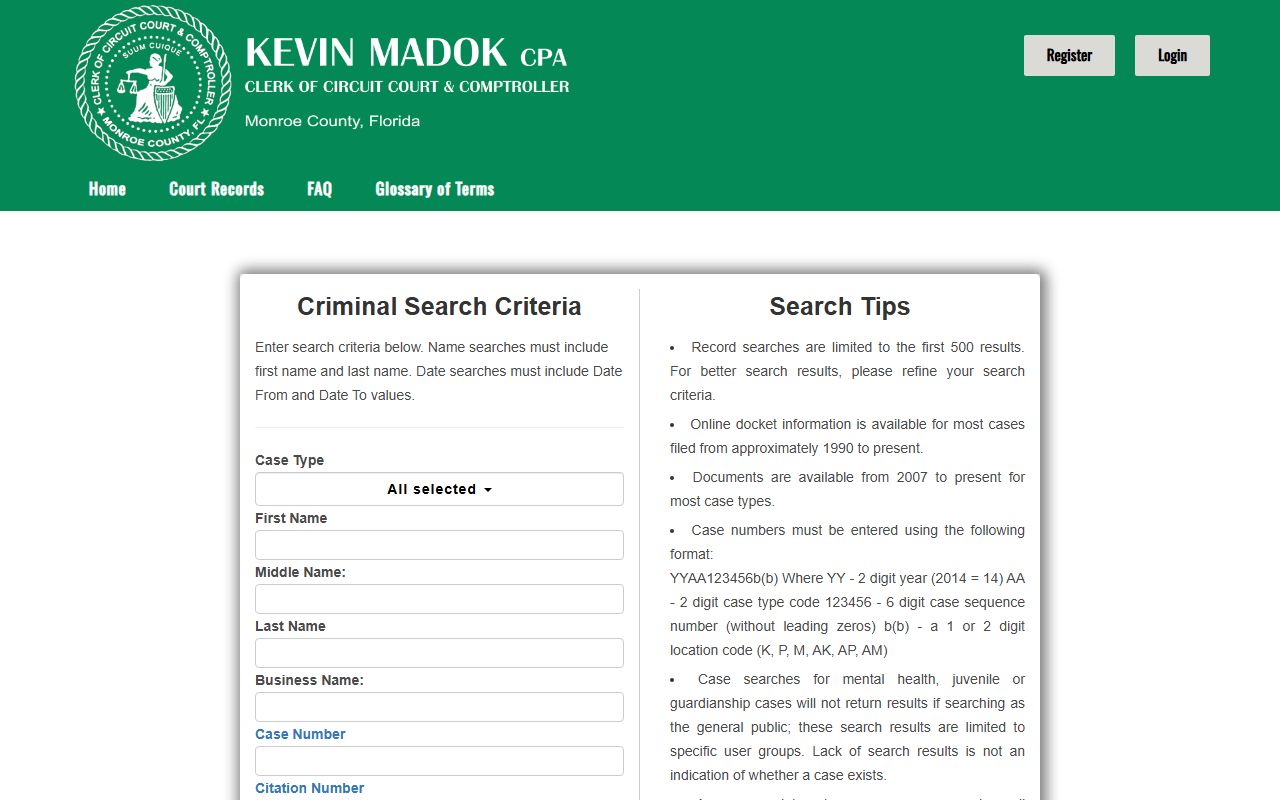
The search form shows the Case Type dropdown, name fields, date range fields, and the case number entry that accepts the format shown on the jail roster.
Clerk Criminal Case Search Field Reference
The Monroe County Clerk criminal search page at cr.monroe-clerk.com has specific rules for each search mode. Name searches require both first and last name. Date searches require both a start and an end date. Case number searches use a format that encodes the year, case type code, sequence number, and a location code. The table below lists every field, its type, and the notes that appear on the official page.
| Field | Type | Required / Notes |
|---|---|---|
| Case Type | Dropdown | Options include Felony, Misdemeanor, Criminal Traffic, Felony - Notice To Appear, Misdemeanor - Notice To Appear, Municipal Ordinance, and more. Select the type that matches the arrest charge level. |
| First Name | Text | Required for a name search. Must be paired with Last Name. |
| Middle Name | Text | Optional. Helps narrow results when a common surname returns many matches. |
| Last Name | Text | Required for a name search. Must be paired with First Name. |
| Business Name | Text | Optional. Used for cases where the defendant is a business entity. |
| Case Number | Text | Format is YYAA123456 plus a location code. Location codes are K (Key West), P (Plantation Key), M (Marathon), AK, AP, or AM. Example: 26CF521AK. |
| Citation Number | Text | Optional. Useful for criminal traffic and UTC case types. |
| Date From | Date | Required for a date search. Must be used with Date To. |
| Date To | Date | Required for a date search. Must be used with Date From. |
| Submit | Button | Runs the search. Results are limited to the first 500 matches; refine criteria if results are too broad. |
Note: online docket information covers most cases filed from approximately 1990 to the present; scanned documents are generally available from 2007 forward. Juvenile, mental health, and guardianship cases do not return results for general public users.
How Charges Are Filed After a Monroe County Arrest
An arrest creates a booking record at the jail, but it does not automatically create a court case. The State Attorney reviews the arrest report and decides whether to file formal charges and in what form. In Florida, the most common charging document for felonies is an information filed directly by the State Attorney. Misdemeanors can move forward on a complaint or a notice to appear. Serious felonies can be charged by indictment through a grand jury. The prosecutor may also decline to file, which closes the court side without a conviction. In Monroe County, State Attorney Dennis W. Ward leads the 16th Judicial Circuit office at keyssao.org.
| Complaint | Information | Indictment | |
|---|---|---|---|
| Filed By | Officer or prosecutor | Prosecutor (State Attorney) | Grand jury |
| Common For | Misdemeanors and initial arrest charges | Many felonies in Monroe County | Serious or capital felonies |
| Opens a Case | Yes | Yes | Yes |
The State Attorney's public-records request page at keyssao.org/226/Public-Records-Requests explains how to request prosecutor-held records. Include the case number, the defendant's name, and contact information in any request. Written requests go to Office of the State Attorney, 530 Whitehead Street, Suite 301, Key West, FL 33040. Email: prr@keyssao.org. Phone: 305-292-3400.
The screenshot below is taken from the Monroe County State Attorney's Office homepage at keyssao.org.
The homepage identifies Dennis W. Ward as the elected State Attorney and gives the main contact block for the 16th Judicial Circuit office in Key West.
Charge Status in Monroe County Court Records After an Arrest
Charges can change at any point between the arrest and the final case outcome. The booking charge the jail roster shows is often the arrest charge an officer entered at intake. Once the State Attorney reviews the file, the prosecutor may file different charges, add counts, reduce a felony to a misdemeanor, or decline to pursue the case at all. The clerk's docket tracks every change. Anyone reading a court record after a Monroe County arrest should compare the original booking charge against the current clerk docket entry, because the two often differ.
| Status | What It Means |
|---|---|
| Pending | The charge is active and the case is still moving through the court process. No verdict, plea, or dismissal has been entered. |
| Amended / Reduced | The prosecutor changed the original charge. A felony may become a misdemeanor, a count may be reworded, or additional counts may be added by an amended information. |
| Dismissed | The court ended the charge, often on a motion. Dismissal does not always mean a finding of innocence; it means the charge did not proceed to a conviction. |
| Nolle Prosequi | The State Attorney chose not to pursue the charge. The prosecution formally abandons the case. The arrest record may still exist even after a nolle prosequi unless the record is later sealed or expunged. |
Bond and Release After an Arrest in Monroe County
After an arrest, bond is addressed at a first appearance hearing under Florida's pretrial release statute, section 907.041, and under the 16th Judicial Circuit's administrative bond schedule. The jail roster shows the bond amount, or "No Bond," on each case number line. Some people receive a scheduled bond amount and can post it without waiting for a judge. Others must appear before a judge at first appearance, where the court weighs the facts and decides whether release or detention is appropriate. A hold or detainer from another agency can keep a person in custody even after one bond is posted.
| Bond Type | How It Works |
|---|---|
| Cash Bond | The full bond amount is paid directly to the jail or court. Funds are returned minus fees when the case closes if conditions are met. |
| Surety Bond | A licensed bail bond agent posts a surety for the defendant, charging a non-refundable premium, typically ten percent of the bond amount. |
| PR / Own Recognizance | The court releases the person on a promise to appear, with no cash required. Conditions such as check-ins or no-contact orders may apply. |
| No-Bond Hold | No release amount is set for that charge or hold. Common for serious felonies, probation violations, out-of-county warrants, or when a judge orders detention pending trial. |
| Hold / Detainer | A request from another agency, such as a probation office or out-of-county court, keeps the person in custody even if a separate bond is posted on the local charge. |
Case numbers on the bond line encode the filing type and location. CF stands for felony; MM stands for misdemeanor. The location codes K, P, and M on the roster correspond to Key West, Plantation Key, and Marathon court locations. A bond line reading "No Bond - 26CF521AK" means a felony case filed in Key West with no release bond currently set.
Warrants That Lead to a Monroe County Arrest
Many bookings follow an outstanding warrant rather than a fresh on-view arrest. The Monroe County Sheriff's Office publishes its active warrant list at keysso.net/warrantsA, with pages organized alphabetically by last name from A to Z. The page warns: "Do NOT attempt to make any arrests or apprehensions based on this information." Members of the public who believe a warrant has been resolved or incorrectly listed should call the MCSO non-emergency line at 305-853-3211 rather than attempting any action on their own.
Common warrant types that land someone on the Monroe County jail roster include bench warrants issued for failure to appear at a court date, probation violation warrants under Florida section 948.06, and out-of-county warrants where another jurisdiction wants the person. When someone is booked on a warrant, the arrest feed may show charge language such as "OUT-OF-COUNTY WARRANT," "FAILURE TO APPEAR," or "PROB VIOLATION." The court record for the underlying case lives in whichever clerk's office originally opened the case, which may not be Monroe County. Searching both the Monroe Clerk and the originating county's clerk system may be necessary.
To look up active Monroe County warrants by browser search, open the appropriate letter page, press CTRL-F, and type the last name. Warrant entries include the name, physical description, last known address, charges, warrant number, issue date, and bond. If a warrant is tied to an open Monroe County case, the clerk criminal search at the case number will show the underlying docket.
Charges vs. Convictions in Court Records After an Arrest
A charge is an accusation. A conviction is the result of a guilty verdict or a guilty plea. Being arrested and charged is not the same as being found guilty. Court records after a Monroe County arrest will show both the accusation and, eventually, the outcome. Both are public records under Florida Chapter 119, which means someone reading the clerk docket can see the original charge alongside any dismissal, acquittal, or conviction without knowing immediately which happened first or why. Reading the full docket rather than just the charge line gives the most accurate picture of where the case stands.
| Charge (Accusation) | Conviction (Verdict or Plea) | |
|---|---|---|
| Stage | Accusation by prosecutor after an arrest | Guilty verdict at trial or an accepted guilty plea |
| Burden of Proof | Probable cause that a crime occurred | Beyond a reasonable doubt |
| Public Record | Yes | Yes |
Note: a dismissed charge or a nolle prosequi entry in the clerk record means the prosecution ended without a conviction, not that the arrest was erased from the public record.
Sealed vs. Expunged Records After a Monroe County Arrest
Florida law allows some arrest records to be removed from public view after a case ends in a qualifying way. Sealing and expunction are separate remedies with different effects. Sealing hides a record from public view but does not destroy it. Expunction goes further and treats the record as if it never existed, though some restrictions remain. Both require a court order, and neither is automatic. Eligibility depends on the charge level, the case outcome, and whether the person has any prior sealing or expunction history. Florida sealing is governed by section 943.059 and expunction by section 943.0585. Both processes run through the Florida Department of Law Enforcement and then the court.
| Sealed | Expunged | |
|---|---|---|
| Visibility | Hidden from public view; the record still exists but is not returned in a public search | Destroyed or treated as never having existed; the agency must comply with the court order to physically destroy the record |
| Law Enforcement Access | Limited; certain agencies can still see sealed records for specific authorized purposes | Very limited; access is narrower than for sealed records, though some law enforcement uses remain |
| Eligibility | Florida section 943.059; typically requires no prior conviction, only one prior sealing, and a qualifying disposition such as a dismissal or withhold of adjudication | Florida section 943.0585; stricter requirements, generally requires an expunction-eligible disposition and no prior sealing or expunction in most circumstances |
When a record is sealed or expunged, the clerk criminal search will not return it for a general public user. A "no result" in the online index does not confirm a sealing or expunction, because the same result appears when a case simply has not been filed yet, the name was entered incorrectly, or the record is confidential for another reason.
Restricted Court Records After an Arrest in Monroe County
Not every arrest leads to a publicly visible court record. Florida law, court rules, and specific exemptions under section 119.0714 and related provisions can keep certain records out of public reach. The Monroe County Clerk's online search page notes that anonymous internet users can view all records except those expunged or sealed, automatically confidential under Florida Rule of Judicial Administration 2.420(d)(1), or made confidential by court order. Juvenile cases do not return public results at all. Mental health and guardianship matters are also excluded from the general criminal search.
- Juvenile arrests - Cases involving defendants who were under 18 at the time of the offense are confidential and will not appear in the public criminal case search.
- Sealed records - A court order under section 943.059 removes the case from public search results without destroying the underlying file.
- Expunged records - A court order under section 943.0585 requires physical destruction of the record; the clerk's online index will not return it.
- Active investigation exemptions - Records tied to an active criminal investigation may be withheld under Chapter 119 exemptions until the investigation closes.
- Confidential under court rule - Some records are automatically sealed under Florida Rule of Judicial Administration 2.420(d)(1) without needing a separate court order.
When a search returns nothing and the reason is unclear, the best steps are to verify the spelling and case number against the jail roster, try the clerk's in-person office, or contact the State Attorney's office if the interest relates to a case the prosecutor's office handled.
Background Check Considerations
Employers, landlords, and licensing bodies sometimes search court records and arrest history as part of a screening decision. Florida court records accessible through the Monroe County Clerk are public records, but using those records for employment, housing, credit, insurance, or similar decisions triggers requirements under the federal Fair Credit Reporting Act. An FCRA-regulated consumer reporting agency must meet accuracy, dispute, and disclosure rules that the clerk's public portal does not.
Important: This website is not a consumer reporting agency under the Fair Credit Reporting Act, and nothing published here may be used for credit, employment, tenant screening, insurance, or any other FCRA-regulated purpose.
For decisions that require FCRA compliance, the right tool is a licensed consumer reporting agency that obtains and delivers criminal history data under the Act's rules. The Monroe County Clerk's public portal and the MCSO online roster are public reference tools, not FCRA-regulated reports. Florida criminal history for employment and licensing purposes is separately managed by the Florida Department of Law Enforcement through its background screening services.